


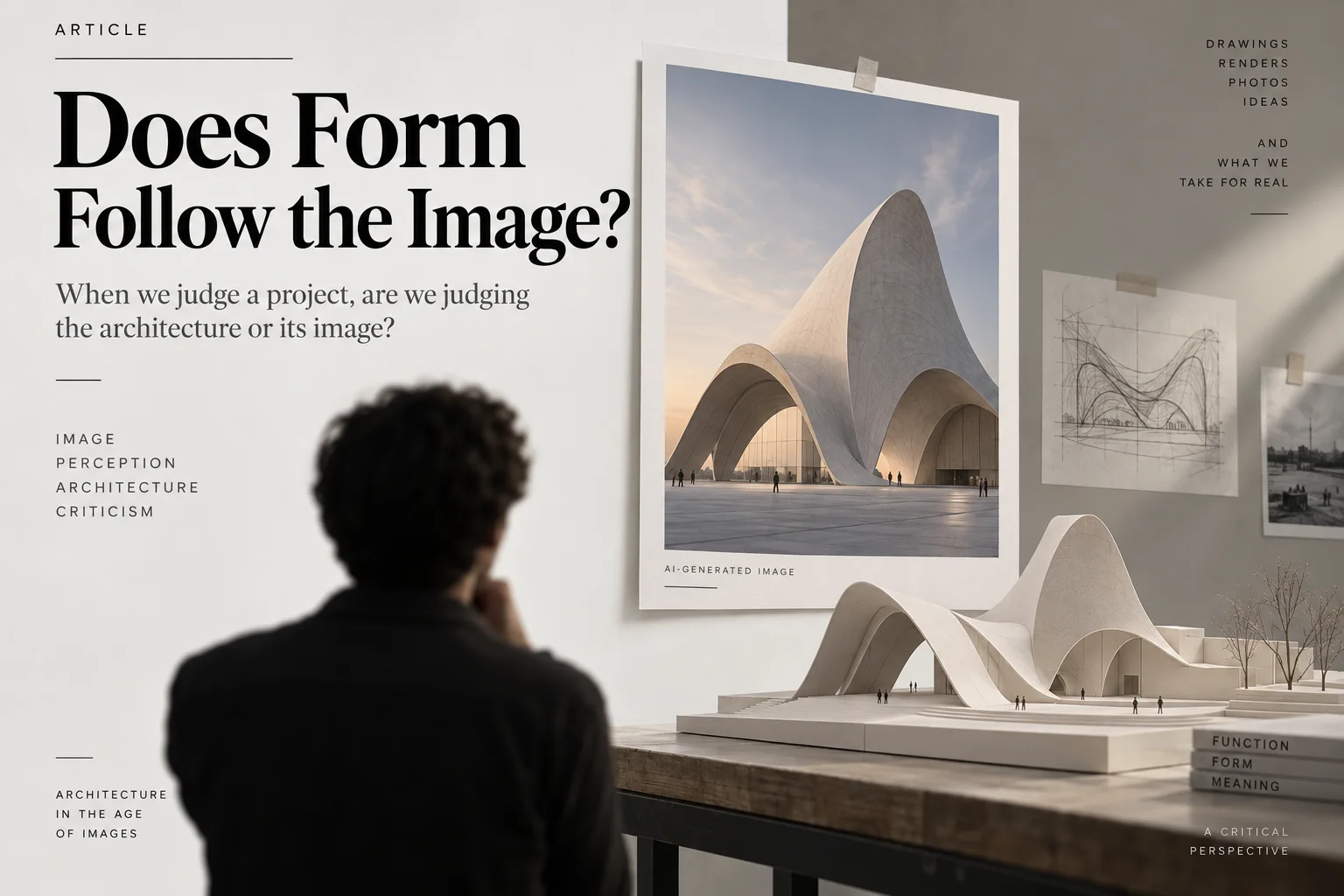
Reflections on Architecture’s Shifting Relationship with Function, Form, and Meaning
At the Arab Architecture Critics Association, Dr. Mashary Al-Naim and Eng. Abdullah Bushlaibi opened a discussion about the shortlist for the international architectural competition to design the Islamic Center in Turku, Finland, organized by the Abdullatif Al Fozan Award for Mosque Architecture. We had received the shortlist presentation file: 113 pages containing 26 projects selected from more than a thousand entries submitted from over fifty countries.
The discussion was compelling from the very beginning. I decided to put everything else aside, made myself a cup of coffee in my backyard, and reopened the file, moving through the images one by one. As I sat there, I found myself caught in a mixture of fascination and resistance, two reactions that rarely come together so strongly for me at the same moment.
I then returned to the conversation and began reading what had been written. One passage by Dr. Mashary Al-Naim made me stop. I quote it here as it appeared:
“The spatial solutions, the response to the site, and the way the form emerged were not shown in the shortlist file...”
I stayed with that observation for some time. I had already been browsing the file for nearly an hour, yet it had never occurred to me to ask about what I was not seeing. There was not a single plan, not a single section, not even a line of text. Only images, roughly four for each project, all in high resolution and presented with remarkable polish, page after page. All of this had passed before me without producing the slightest sense that something was missing, until someone else drew my attention to it.
It was then that I realized his observation went further than I had first thought. The issue was not simply the absence of drawings, but the absence of anything that would allow us to trace the logic of the design. How did this form come into being? What reading of the site gave rise to it? What kind of spatial relationships does it propose? These questions might remain unanswered even if every plan were shown, because they concern the visibility of the thinking behind the design, not merely its documentation.
The question came late: what, exactly, had I been criticizing a few moments earlier?
Was I criticizing the architecture, or its image?
This article is an attempt to answer that question, or at least to take it apart.
What Kind of Image Are We Talking About?
Before going any further, the term itself needs to be clarified. In architectural discourse, the word “image” carries at least four overlapping meanings, and confusing them can make the argument appear stronger than it really is.
There is the image as representation in the broadest sense: everything that stands between an idea and a building, whether a drawing, a plan, a section, or a model. There is also the mental image an architect carries before drawing the first line, a longstanding source of architectural imagination, and hardly something one could object to. Then there is the render, understood as the technical product of a visualization process. And finally, there is the image as the material circulated by digital platforms, competition juries, and architectural publications: the form in which architecture reaches those who discuss and judge it.
It is this fourth meaning that concerns me here. When I use the word “image” in what follows, I mean the medium, not the tool, and not the imagination that precedes design.
A Debate That Was Never Settled
The relationship between form and function has remained one of the most persistent questions in modern architectural thought. The importance of this debate was never really its ability to produce a final answer, but rather the questions it kept open for successive generations of architects and critics. Does form arise from the demands of function, or does it possess a logic of its own and a degree of independence from it? Can architecture be reduced to the efficiency of its performance, or does form carry meanings, symbols, and values that make it more than a response to a functional program?
The debate was never settled, and perhaps it would be a mistake to expect it to be. Architecture at its best has never been a victory of function over form, nor of form over function. Their relationship has always been more complex. Use becomes entangled with place, material with memory, composition with significance, and human need with the desire to give physical existence a meaning that goes beyond immediate utility.
For that reason, there has always been a third element between form and function, one that does not appear as clearly in theoretical formulas but is present in every architecture that carries genuine value; meaning.
Function asks what a building does. Form asks how it exists. Meaning concerns what that existence represents to us as human beings.
At this point, it becomes difficult to separate the three completely. A place does not become architecture simply because it performs a function, just as it does not become architecture simply because it assumes an intriguing form. It becomes architecture when the relationship between the human being, space, material, light, and movement gives rise to an experience capable of carrying meaning.
A Fourth Element Enters the Equation
The technological transformations that have reshaped the production of architecture over the past few decades have introduced a new element into this debate. The question is no longer only about the relationship between form, function, and meaning. The visual medium has entered that relationship with a force that is increasingly difficult to ignore.
Representation, of course, is nothing new to architecture. It has been bound to the discipline ever since architects began drawing what they imagined before building it. Architectural history is full of moments when representation went beyond the thing it represented. Piranesi’s engravings documented an existing Rome, yet exaggerated its scale and recomposed its scenes until they created another Rome in the European imagination. Zaha Hadid’s paintings could exist as visual projects in their own right before becoming propositions for construction. Venturi, Scott Brown, and Izenour, through the distinction between the “duck” and the “decorated shed,” explored architecture’s capacity to become a sign in itself, a building whose very form is meant to be read.
But these were exceptional explorations by architects who knew exactly what they were doing with them. What seems different today is that the image has become the dominant medium through which most architecture reaches most of those who discuss it. It is no longer an exceptional case, nor necessarily a conscious choice.
Modelling and visualization tools have given architects an unprecedented ability to see what does not yet exist. An architect can now produce in hours what once required weeks, test dozens of possibilities, and observe material, light, people, and changing seasons before many architectural decisions have fully settled. This is, without question, an extraordinary cognitive and design capacity. Yet every new capacity rearranges the relationship between a tool and the person using it. It also raises a question about the ways in which a medium may begin to influence the very thing it is supposed to help produce.
This is where the real question begins. What happens when the image is no longer merely the result of an architectural decision, but becomes one of the forces driving it? What happens when a project’s ability to produce a powerful image becomes part of the criteria by which it succeeds, not only at the presentation stage, but from the earliest moments of its formation?
In theory, at least, we could once imagine the design process as moving from need and program to spatial relationships, from spatial relationships to form, and finally from form to an image that explains it. Today, in some cases, that sequence may be reversed. The process begins with an imagined image, a formal configuration gradually crystallizes from it, and space and program are then rearranged to accommodate it.
This does not mean that the first path is morally or architecturally right and the second wrong. Architecture has never historically begun from function alone, and no architect has ever approached a project with a mind emptied of images, symbols, and memories. But there is a difference between the image being one source among many within architectural imagination, and its becoming an independent force capable of imposing its own logic on the other elements of the project.
From this perspective, the old question, “Does form follow function?” is no longer sufficient on its own to understand the present moment.
We need to add another question:
Has form, in some contemporary architecture, begun to follow the image?
Interrogable and Persuasive Representation
One possible objection is that the image is not the only form of representation that selects, because all representation is selective. That objection is entirely valid.
A floor plan is not the reality of a building. It is an imaginary cut taken at an agreed height, one that removes light, sound, time, and material, and assumes an eye suspended above the building, an eye that does not actually exist. The same is true of the section, and of the elevation. There is no innocent form of representation, no transparent window onto the building itself. So if the image is accused of selecting and concealing, the same accusation can be made against every architectural medium.
For this reason, I believe the real distinction is not between image and reality, but between two modes of representation: representation that can be interrogated, and representation that persuades. The boundary between them is not absolute. A render can certainly become an instrument of examination, just as a plan can become an instrument of persuasion. The difference lies in how much each form of representation allows us to question when it is presented on its own.
A plan makes a claim that can be challenged. I can demonstrate that a circulation route ends in a dead space, that the ratio between the ablution area and the number of worshippers is inadequate, or that the women’s entrance imposes an unnecessary detour. Its errors can be demonstrated, and for that reason it becomes material for criticism. It invites examination.
A render, by contrast, often invites us to receive before we examine. It may contain verifiable information about light, materials, transparency, or scale, but its principal strength lies less in revealing its logic than in producing an effect. When persuasive representation becomes the only material available to us, criticism does not merely lose precision. The very range of what can be verified or disproved begins to narrow, and that is more troubling.
We see a space immersed in gentle light, but we do not know what it will be like at noon, or during a long winter evening. We see a group of people using the courtyard, but we do not know how movement through the entrances and exits will work when the building is full. We see someone sitting in a corner that suggests intimacy, but we do not know whether the proportions, acoustics, temperature, and materiality of that place will produce the same feeling once it becomes real.
The image does not necessarily lie, but it selects. Every act of selection reveals something and conceals something else. What makes the image particularly powerful is that it can conceal without leaving an obvious trace of that concealment.
This is where one of the most significant shifts in contemporary architectural culture becomes visible. We have become capable of producing a convincing image of an experience before the experience itself exists. An image can produce calm, suggest reverence, and create a sense of social warmth or belonging while the building itself remains only a possibility.
That does not make the image false. But it does mean that the image carries a promise, one that can only be tested when architecture becomes a real place, when a person enters it, moves through it with the body, and experiences it through time.
The Human Figure and Its Presence
The human figure is everywhere in contemporary architectural imagery. We see people walking, sitting, playing, reflecting, and worshipping. Yet at times, the human being seems to be present more as an element in the composition of the image than as a principle in the making of the architecture itself. There is a considerable difference between placing a person in a render to indicate scale and allowing human scale to genuinely shape the space.
The architectural human is not a silhouette added to a scene. It is a body that moves, pauses, tires, sees from a particular height, and looks for shade, privacy, and safety. It carries memory, culture, and a sense of place. It is also bound to time, because a space that appears balanced in one moment may reveal an entirely different character when it fills with people, when the light changes, or when the seasons turn.
This should make us reconsider even some of the words we use so casually in architectural criticism. When we describe a project as “human,” what do we actually mean? Do we mean that the image looks humane, or that the organization of space, movement, scale, material, sound, and light truly places the human being at the center of the experience?
At this point, I have to stop and ask myself a more personal question: how did I know that the people in these projects were elements of composition rather than principles of design?
I did not know. I knew only what the images allowed me to see.
My own judgment, then, suffers from the very flaw I am trying to diagnose. It has no more evidence than the image itself provides. And this, precisely, is the heart of the problem. The issue is not simply that images may deceive us. It is that they can give us a confidence in our judgments that the material before us does not actually support, whether we are praising a project or criticizing it.
It Is Not Merely a Technical Problem
It would be easy to turn all of this into a complaint about technology. But that would reduce the problem too much. Technology does not, by itself, produce superficial architecture, just as traditional tools never guaranteed depth. Visualization is an extraordinary instrument of knowledge, and simulation has allowed architects to understand aspects of their projects that were previously difficult, or sometimes impossible, to test in advance.
There is also a counterargument that deserves to be taken seriously. Early visualization forces the architect to confront questions of light, material, and scale far earlier in the design process than was once possible. An architect drawing in ink would often see the consequences of a material decision only much later, and perhaps never see them fully before construction. The ability to simulate can deepen a design rather than flatten it.
I think this argument is valid, and I accept it.
But it describes the tool in the hands of someone who knows what to ask of it. The problem is not that the tool has become more capable. The problem is that its capabilities may begin to change the questions we ask. A tool that answers the question “What might the project look like?” with remarkable ease makes that question easier to ask than others. And the easier question has a tendency to be asked first, and eventually, perhaps, to be asked alone.
This is intensified by the fact that the forces at work here are not purely intellectual or design-related. Competition juries read presentation boards, not buildings. Architectural publishing platforms depend heavily on visual circulation. Real estate marketing sells the image before it sells the place. The image has an economy behind it, an economy that does not deliberately work against architecture, but that consistently rewards one dimension of it. Over time, that dimension can become the shortest route to success.
Modern generative tools, in my view, do not simply add more images to this condition. More importantly, they lower the barrier between appearance and structure. Digital visualization based on three-dimensional modelling was, in most cases, derived from a model with defined geometry. Somewhere behind the image there was a plan, an elevation, and some form of spatial relationship, however preliminary.
Today, however, a convincing architectural effect can be produced with far less effort than the architectural decision that once had to exist behind that effect. I am not suggesting that images today have no geometry beneath them. Most still do. But the amount of work once required to ensure that a persuasive image had an architectural decision behind it has fallen dramatically. That alone is enough to alter the balance of the process.
And the more skilled our tools become at answering the question of appearance, the more necessary it becomes to keep the other questions alive.
Why does this project exist? Who is it for? How will it actually be lived in?
And what will happen between the human being and the place when the screen disappears, and the image becomes wall, floor, light, heat, sound, and distance?
Criticism Itself Under Question
At this point, criticism itself becomes responsible for restoring some balance, because it does not stand outside this visual culture. We, too, move at the pace of the image. We see more projects than any previous generation has seen, yet they pass before us at a speed no previous generation had to confront. Within seconds, we decide that a project is beautiful, cold, humane, or overly formal, and then we move on to the next.
One of the tasks of criticism today, then, is not simply to critique what it sees, but to ask how it came to see it in the first place. What do I actually know about the project? What have I inferred from the image? What did the image make me feel, which I then assumed to be a quality of the building itself?
I am not suggesting that criticism should stop whenever images are all we have. That would simply paralyze criticism rather than solve the problem. What I am suggesting is a change in the nature of the question. Instead of moving immediately toward judgment of the project, criticism can begin by interrogating the image itself.
What has been left out of this scene? What moment of the day was chosen, and why? What architectural question might a single plan reveal that the image cannot answer?
A critic who has nothing but the image can, at the very least, make the limits of that knowledge explicit in the text and openly ask for what is missing. That demand is itself an act of criticism.
And here I return to the file from which all of this began. What troubles me is not that the document consisted only of images. That is understandable for a presentation file at this stage. What troubles me is that I spent so long looking at it without once thinking to ask what I was missing, until someone else raised the question for me.
The image was not enough for me to judge.
But it was enough to make me feel that I was judging.
The absence of a plan or section from a document through which architecture is presented to critics no longer necessarily produces a sense of absence. The image has not defeated architecture. But it has become the form through which architecture reaches us, and the medium through which we practice criticism while believing that we are practicing it on the building itself.
A Network, Not a Binary
The debate between form and function has not ended. It has simply become more complex. Meaning was there between them all along, and today the image adds another layer of mediation and power. The equation is no longer simply one of form and function, but a network of relationships among function, form, meaning, and image.
The challenge is not to eliminate any one of these elements, but to prevent any one of them from reducing the others to itself. When architecture is reduced to function, it becomes mere performance. When it is reduced to form, it becomes composition. And when it is reduced to image, it becomes something more unsettling: a persuasive representation of an experience whose existence outside the image we can no longer take for granted.
The last century kept asking:
Does form follow function?
Today, we are compelled to ask:
Has form begun to follow the image?
And perhaps the very structure of this question still carries something of the sequential model I am trying to move beyond. Perhaps the image no longer comes before form or after it. Perhaps it has become a parallel path, with its own economy, its own audience, and its own criteria of success, capable of separating from the building and no longer needing it in order to feel complete.
If that is the case, then the question is no longer about the order of elements. It is about architecture itself dividing into two things: one that is built and lived, and another that is seen and circulated.
And the two may not always meet.
In either case, what should concern us is not only the fate of form, but the fate of what has always been at the heart of architecture: the human being, meaning, and the experience that no image, however powerful, can ever live on our behalf.