Category: Uncategorized

  • The Living Dialogue of Criticism: Between Preservation and Creation

    Reading Time: 2 minutes

    Criticism, at its heart, is far more than an instrument for exposing flaws. I have come to see it as a quiet but persistent force that shapes the evolution of thought itself. It operates not only by refining what already exists but also by opening spaces where new ideas can take root. Looking back on my own academic journey, and on many rich conversations with friends and mentors, I realize that genuine criticism acts less like a hammer striking down and more like a hand guiding forward, sometimes gently, sometimes with great insistence.

    There is, of course, the obvious role of criticism: to strengthen and polish existing ideas. Identifying the gaps, the inconsistencies, the subtle weaknesses—this process is indispensable if knowledge is to remain alive and relevant. A well-placed critique can rescue an argument from becoming hollow or repetitive. Over time, I have found that the most valuable insights often come not from praise but from the careful, sometimes uncomfortable attention of a critic who dares to point where a thought is still fragile. Like a craftsman refining a piece of work, criticism teaches us to see our own thinking anew, to sharpen what has dulled, and to mend what risks falling apart.

    Yet the deeper power of criticism lies, I believe, in its ability to provoke creation. True criticism is an act of opening, not closing. It challenges what we think we know and invites us to imagine what might lie beyond. I think often of my late friend and colleague, Dr. Walid Al-Sayed, whose untimely passing left a profound silence in our scholarly world. Our conversations about the so-called “Islamic city” were never about confirming established ideas; they were about questioning them—sometimes gently, sometimes with the full force of doubt. Dr. Walid had a gift for making even the most venerable concepts seem newly fragile, newly worthy of interrogation. In those discussions, I realized that questioning was not destruction; it was a form of care, a deep commitment to keeping thought alive and awake.

    Through such dialogues, it became clear to me that criticism is not a linear process of correction followed by completion. It is a cycle, a dance between understanding and questioning, accepting and challenging. Sometimes it repairs, sometimes it breaks open—but always, it moves thought forward. And in that movement, it breathes life into fields of inquiry that might otherwise grow stale under the weight of tradition.

    Reflecting on all this, I feel that criticism deserves to be seen not as a threat but as an act of trust—a trust that thought can grow, that our minds are capable of more, and that no idea, however cherished, is beyond refinement or renewal. It is through critical engagement, both of ourselves and of the ideas we inherit, that we honor the intellectual legacies we are part of, even as we dare to push them further.

    In the end, criticism is not only about correcting; it is about believing that something better, something truer, is always possible.
  • Walking Through Memory: Cities as Keepers of Identity

    Reading Time: 3 minutes

    Urban memory has always fascinated me, not simply as an abstract concept but as a living part of who we are. Cities, after all, are not just made of concrete and stone; they are built from the layered memories of generations. Walking through any old street or standing before a weathered monument, one can feel that silent conversation between past and present. The importance of urban memory lies precisely in how deeply it intertwines with cultural and social identity, shaping both communities and individuals in ways often too subtle to notice until something is lost.

    I have seen firsthand how buildings, streets, and public spaces become vessels for shared history and values. In Moscow, I often found myself reflecting on how every stone of Red Square seemed to pulse with echoes of different eras. The towering walls of the Kremlin were not just impressive architecture; they felt like guardians of memory, keeping alive centuries of stories about triumphs, revolutions, and resilience. Simply walking there made me feel part of a much longer, larger narrative.

    In Almaty, Kazakhstan, the experience was different yet no less powerful. I still remember strolling through Panfilov Park, where the vibrant greenery coexists with solemn war memorials. There was a tenderness in the way people would pause to place flowers, a quiet recognition that these spaces hold more than just aesthetic value; they embody sacrifice, endurance, and collective pride. I would often pass by the Green Bazaar, and every visit would trigger personal memories—the scents, the bustle, the sense of belonging that no grand monument could replicate.

    And then there is London, a city where memory feels stitched into the very cobblestones. There, I often found myself wandering through streets where Victorian facades stand proudly beside modern glass towers, a living testament to the city’s ability to carry its past with it into every new chapter. I once paused in front of the Cenotaph, not during any official ceremony but on an ordinary day, and still felt a weight of solemnity, a reminder that the past is never far from our daily lives.

    It is through these experiences that I realized urban memory operates on two levels at once. Collectively, it weaves communities together, providing shared reference points that anchor a society’s identity. Destroying a landmark, therefore, is never merely a physical loss; it is an attack on the continuity of memory, an attempt to destabilize how a community sees itself. I have witnessed the quiet grief that follows when familiar places are erased, whether by war, neglect, or reckless modernization. The sense of disorientation that follows is not just about losing a beautiful building; it is about losing a part of oneself.

    On a more personal level, urban memory shapes the landscapes of individual identity. Specific places lodge themselves into our private histories. A certain street corner becomes tied forever to a joyful encounter, a particular park bench to a moment of deep reflection. I think of that quiet street in Moscow’s Arbat district where I once lived, where each turn held memories of friendships and daily routines. I think of Almaty’s bustling markets, where I often wandered with a child’s wide eyes, absorbing a world that would later shape my understanding of home. I think of London’s hidden squares and quiet river walks, where moments of solitude taught me as much about myself as any formal education could.

    What strikes me most is how these places continue to live inside us long after we have left them. Their memory gives continuity to our lives, connecting who we were to who we are becoming. Losing them—or seeing them transformed beyond recognition—can feel like losing an old friend. It reminds us that identity is not built only in our minds but also etched into the physical spaces we inhabit.

    Cities, at their best, are not simply spaces for commerce and movement; they are repositories of shared life. Preserving urban memory, then, is an act of cultural and personal preservation. It is an acknowledgment that we owe something to the past, not out of nostalgia, but out of a recognition that memory gives depth to the present and hope for the future. When we protect the spaces that carry meaning, we are not just saving old stones; we are safeguarding the invisible threads that bind us to our history, to each other, and ultimately, to ourselves.

  • Acceleration and Depth: Rethinking the Question of Renaissance in Arab Consciousness

    Reading Time: 2 minutes

    There remains an unresolved gap—one that runs deep in the fabric of contemporary Arab consciousness. A gap between what we see and what we truly understand; between what changes around us and what transforms within us. A gap between the fast pace of visible development and the deeper, slower currents of rooted change.

    On the surface, it may seem that our reality is moving toward remarkable transformations. Yet upon closer reflection, it becomes clear that much of what is changing around us does not necessarily reflect a parallel transformation within us. This raises a fundamental question:

    Are we truly reshaping ourselves, or are we merely rearranging the elements around us?

    In my view, any meaningful renaissance—one that should be the true engine of transformation in our region—does not begin with appearances, but with the human being. With an individual who understands their place in the world, and carries within them a project that aligns thought with ethics, and identity with action.

    This person is the foundation of any genuine transformation. Everything else may eventually fade, regardless of how impressive it might appear at first.

    Conversely, we should not dismiss imitation or external borrowing as inherently negative. In many cases, adopting external technologies or administrative models is a necessary step to bridge historical gaps and engage with global currents.

    Great civilizations—whether the Islamic civilization at its peak or modern-day China—did not grow by isolating themselves. They engaged, borrowed, and reworked what they absorbed into forms that suited their own trajectories.

    The famed “Bayt al-Hikma” in Baghdad, for instance, was not merely a translation center. It was a living lab for the re-production of knowledge within a cultural and philosophical framework that resonated with its era. The challenge, therefore, is not in acquiring or translating knowledge, but in owning it—remolding it into a coherent vision that balances openness and cultural specificity, modern shifts and ethical roots.

    For this reason, it is essential that we move beyond self-flagellation under the banner of “authenticity,” just as we must resist the illusion of “superiority” when it is based solely on appearances that mask deeper stagnation. What we truly need today is the courage to pose a critical question:

    Do we possess a clear vision—one rooted in our own awareness and in our ethical commitments to our societies and causes—that allows us to fully grasp our present reality and responsibly shape a balanced future?

    This question should not remain confined to thinkers and academics. It should become a vibrant discussion across intellectual, educational, and media institutions—one that ultimately leads to conscious steps toward what could be called a “critical inner renaissance”: A renewal that reshapes our relationship with the self and the collective, and paves the way for a more grounded, independent, and sustainable future.

    In this context, it is not necessarily wrong to benefit—even temporarily—from controversial or unconventional figures. There are moments when such encounters offer opportunities for short-term gains. But this must not become a fixed strategy or a guiding principle. Even individuals who seem beneficial at a given moment may carry within them deeper long-term harm, if not handled with clarity and awareness.

    Finally, not everything presented in the public eye reflects what is truly planned behind the scenes. What happens behind closed doors is often more far-sighted, more complex, and—at times—more honest than the scripted narratives on display. This is why the real wager lies not in spectacle or momentary alliances, but in our ability to understand what we do, why we do it, and where we intend to go.

  • Canada, the UK, and Australia Recognize Palestine: Coordinated Diplomacy and the Urban-Planning Preconditions for a Just Peace

    Reading Time: 3 minutes

    On September 21–22, 2025, Canada, the United Kingdom, and Australia issued coordinated announcements recognizing the State of Palestine. The choreography—timed around the UN General Assembly and echoed across official language—signals a deliberate policy architecture rather than a spontaneous gesture. From a planning standpoint, the step matters because it aligns diplomacy with the spatial realities any viable state requires: contiguity, governability, and the ability to plan and finance infrastructure across a coherent territory.

    Recognition as a planning brief, not merely a diplomatic symbol. Treating Palestine as a recognized political subject clarifies the reference frame for planners: borders as baselines, corridors as public goods, and metropolitan systems as engines of service delivery. It converts a normative claim—self-determination under international law—into a concrete mandate to design institutions, networks, land policy, and fiscal tools that can function at scale.

    Societal dividends through spatial order. Recognition can reduce polarization by recentering universal principles—equal dignity, accountability to humanitarian law, and the inadmissibility of acquiring territory by force—and translating them into spatial practice: safe housing, accessible mobility, and equitable access to land, water, and energy systems. In diverse democracies such as Canada’s, this is also a commitment to policy coherence between values and urban development programming abroad.

    The urban-geographic reality: a cartography of constraint. Years of accelerated settlement construction and the retroactive legalization of outposts, combined with demolition orders, restricted zones, and fragmented jurisdiction, have produced an “archipelago effect” across the West Bank, including East Jerusalem. A lattice of segregated road networks and perimeter regimes interrupts commuting sheds, municipal service areas, and logistics chains. The result is a shrinking envelope for Palestinian contiguity—precisely the condition recognition seeks to preserve.

    Viability in three metrics: contiguity, connectivity, capacity.
    Contiguity requires protecting a north–south territorial spine and securing east–west connectors between governorates.
    Connectivity means rationalizing checkpoints and barriers that sever labor markets and emergency response times, while upgrading public transport and freight corridors.
    Capacity depends on empowered planning institutions, predictable permits, cadastral clarity, municipal finance reform, and the restoration of utilities and social infrastructure across metropolitan clusters such as Hebron, the Bethlehem–Jerusalem–Ramallah corridor, Nablus, Jenin, and the Jordan Valley.

    A narrowing window in physical time. Land-use decisions are path-dependent. Each new settlement plan, road reservation, or land expropriation hardens the spatial structure and raises the cost of future reversals. Recognition, therefore, is also a race against entropy: it creates political cover to pause expansion that forecloses contiguity and to safeguard critical corridors and urban growth boundaries before they are irretrievably fragmented.

    International law as the planner’s compass. The right of the Palestinian people to self-determination and the principle that territory cannot be acquired by force provide a stable, non-negotiable baseline for spatial policy. They align with contemporary planning norms embedded in the Sustainable Development Goals and the New Urban Agenda: inclusive, safe, resilient, and sustainable settlements; equitable access to services; and participation in decision-making.

    From recognition to implementation: priority actions. 1) Immediate moratorium on settlement expansion, outpost legalization, and land confiscations undermining contiguity. 2) Protection and resourcing of Palestinian planning institutions, including transparent permit regimes and a modernized digital cadastre. 3) Designation of national interest corridors for passenger and freight movement, with grade-separated crossings where necessary and a focus on inter-city transit. 4) Integrated water–energy–waste programs to stabilize public health and unlock industrial recovery. 5) Municipal finance tools (land value capture, predictable intergovernmental transfers) tied to performance on service delivery and housing supply. 6) Participatory planning platforms to ensure communities shape neighborhood upgrades, cultural heritage protection, and climate-resilient reconstruction—especially along the coast and in vulnerable valley systems.

    What success looks like in spatial terms. A workable state project is visible on the map: continuous territory; interoperable transport; metropolitan systems that reach hinterlands; protected ecological corridors; standardized development control; and a cadastre that underwrites credit, housing production, and infrastructure finance. Recognition opens the door; spatial governance walks through it.

    Bottom line. The coordinated recognitions by Canada, the UK, and Australia are more than diplomatic theater. They are enabling conditions for urban and regional planning that can translate legal equality into livable geographies. The task now is technical as much as political: freeze the processes that fragment space, secure the corridors that stitch it back together, and equip institutions to plan, permit, and deliver—so that Palestinian self-determination is realized not only in law but in the everyday landscapes people inhabit.

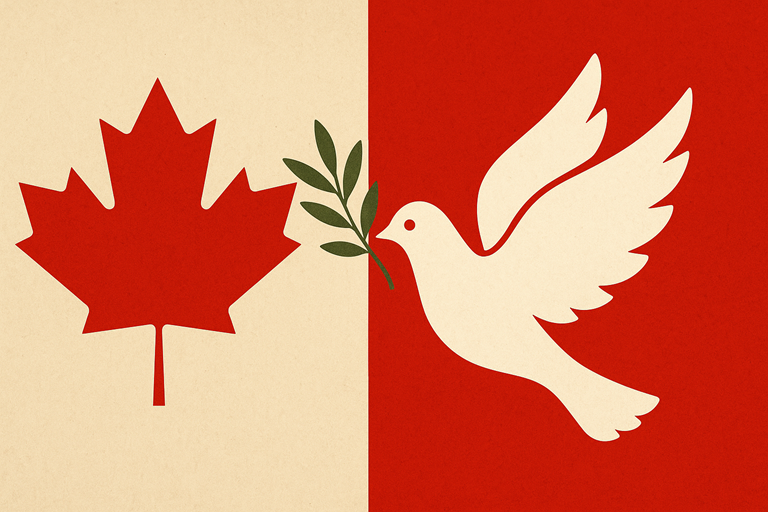
  • Canada’s Recognition of Palestine: A Step Toward Justice and Peace

    Canada’s Recognition of Palestine: A Step Toward Justice and Peace

    Reading Time: 2 minutes

    Canada’s recent recognition of the State of Palestine constitutes a significant and long-overdue advancement in the quest for justice and peace in the Middle East. For decades, Palestinians have existed without a recognized state, while Israel has enjoyed international legitimacy and robust support. By undertaking this action, Canada signaled that fairness, equality, and self-determination are the principles underpinning its foreign policy.

    The timing of this recognition is critical, given the ongoing conflict characterized by Hamas-led attacks on Israel and Israeli restrictions on Palestinian territories, as well as Israel’s military actions in the Gaza Strip, which have diminished the prospects for a two-state solution. Canada’s decision does not intend to criticize Israel’s right to security; rather, it acknowledges that peace cannot be achieved if the statehood of one party is disregarded.

    Some critics argue that recognition encourages violence or bypasses negotiations, but the reality is that talks have been stalled for decades, leaving the Palestinians politically marginalized and vulnerable. Recognition grants them legitimacy, a stronger voice in international forums, and leverage to advocate for reforms and democracy through the Palestinian Authority.

    Beyond its recognition, Canada’s action should also be viewed as an invitation to action, as diplomatic acknowledgment alone cannot alleviate the suffering in Gaza or the West Bank. To ensure that recognition translates into tangible improvements in people’s lives, practical measures are needed, including humanitarian support, reform, and pressure on all parties to comply with international laws.

    Canada’s willingness to assume moral leadership in global affairs is reflected in this decision. It serves as a reminder to the international community that to achieve lasting peace, both sides must be acknowledged, human rights must be respected, and injustice must be addressed wherever it occurs. This recognition is a landmark for Palestinians and a reaffirmation of Canadian values that prioritize justice and fairness.

    Recognizing Palestine is not about choosing sides in a conflict; it is about creating conditions for a future where both Palestinians and Israelis can live in dignity, security, and peace. Canada’s decision is a necessary step toward this vision.